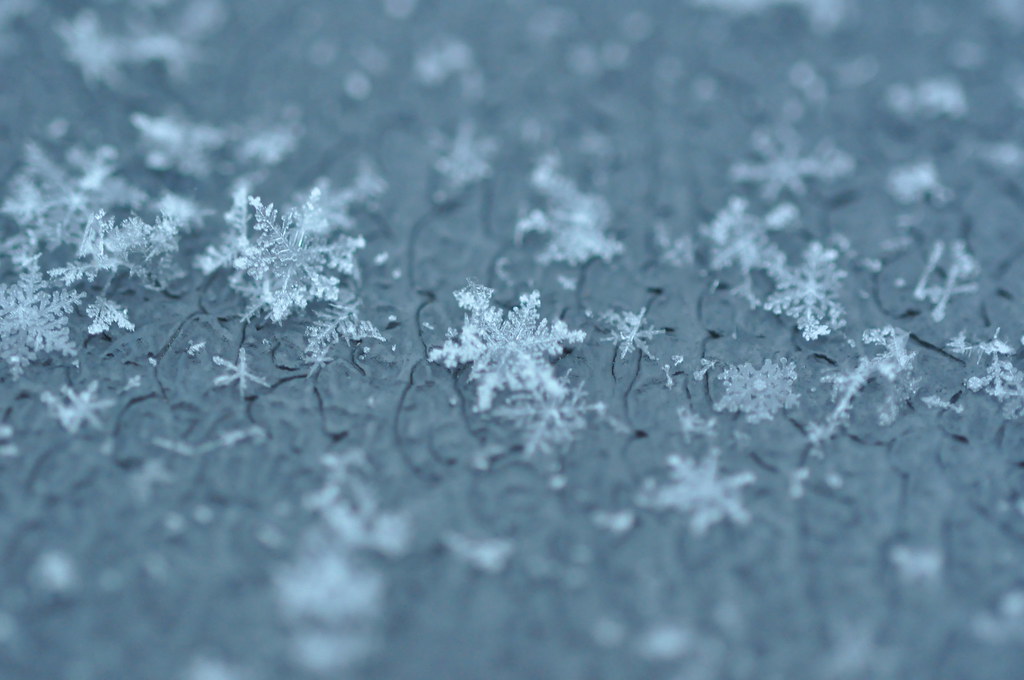
Have you ever caught a snowflake on your mitten and stared at its tiny, delicate shape? If you looked at a hundred of them, you’d see stars, needles, columns, and beautiful lacy designs. But here’s the crazy part: scientists believe that in the entire history of Earth, not a single pair of complex snowflakes have been identical. It’s one of nature’s coolest mysteries. So, how is this possible? Let’s dive into the frosty science behind it!
It All Starts With a Speck of Dust
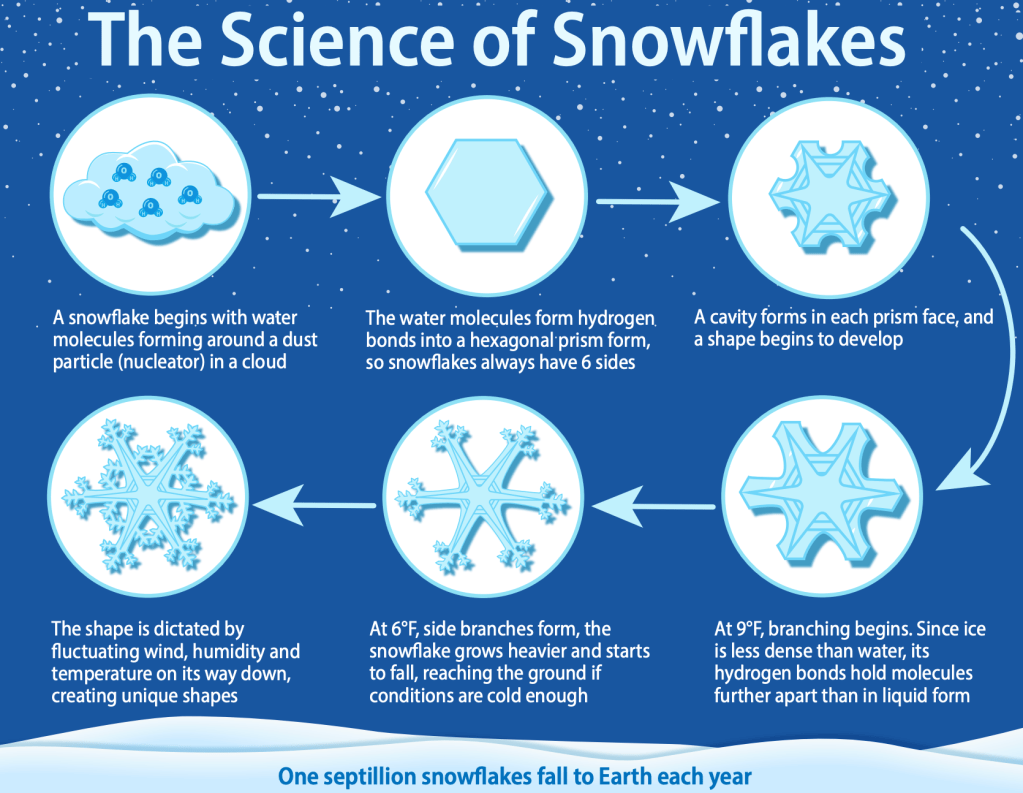
Believe it or not, every snowflake begins with something not very snowy at all: a tiny piece of dust. High up in a cloud, it’s super cold. Water vapor in the air needs a surface to cling to. This is required for it to freeze. This speck of dust, pollen, or even ash from a volcano becomes the “seed” for the snowflake. This is called a nucleation site.
Once the water vapor freezes onto this speck, it forms a simple, six-sided ice crystal. Why six sides? It’s all about the shape of a water molecule. Water molecules (H₂O) like to connect to each other in a hexagon pattern when they freeze. This connection pattern is why snowflakes always have six sides or six arms. You’ll never find a snowflake with eight arms—it’s scientifically impossible!
A Journey Through the Cloud
Now, here’s where the magic happens. The newborn ice crystal begins to fall through the cloud. But the cloud isn’t a static, boring place. It’s a wild ride of changing temperatures and humidity (the amount of water vapor in the air).
As the flake falls, more water vapor freezes onto its six corners. How it grows depends on the exact conditions it experiences:
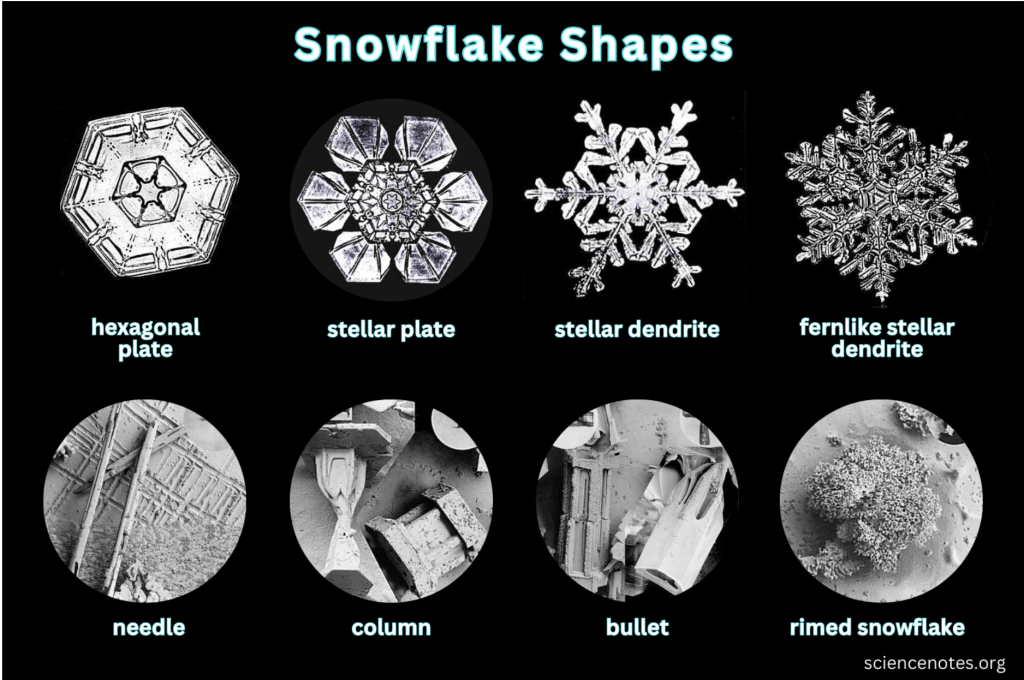
- Temperature is the biggest boss. Slightly different temperatures cause wildly different shapes. Around -2°C (28°F), flakes form thin plates. At -5°C (23°F), they grow into long needles. At -15°C (5°F), we get the classic, lacy star shapes.
- Humidity is the other boss. Higher humidity means more water vapor is available, leading to more complex, branching designs. Lower humidity makes simpler shapes like plain columns or plates.
The Real Secret: A Unique Path
Think of the snowflake’s journey like a personalized obstacle course. No two flakes take the exact same path through the cloud. One might zigzag through a warmer pocket. Then, it could enter a more humid zone. Finally, it might get blown by a gust of wind into a super-cold area. Every single bump, turn, and change in the air adds a tiny detail to its arms.
Since the six arms are so close together, they all experience almost the same conditions at the same time. That’s why the arms look identical—they’re growing in sync. A snowflake starting on the other side of the cloud would have a completely different story. Its life story would be written in its shape.
Scientists like Kenneth Libbrecht, a physicist known as the “Snowflake Doctor,” study this in labs. They can grow “designer snowflakes” by carefully controlling the temperature and humidity. This proves how sensitive the growth process is. Changing the conditions just a tiny bit changes the whole design.
Are They Really All Different?
This is where the “mystery” gets a little funny. When people say “no two snowflakes are alike,” they are referring to the complex and branched snowflakes. These are the types you can see under a microscope. Simple snowflakes, like tiny hexagonal plates, can look identical because there’s not much detail.
But for a complex snowflake? The math is mind-blowing. Millions of water molecules arrange themselves based on a one-of-a-kind journey through a chaotic cloud. The chances of two flakes forming with every single arm and detail matching perfectly is essentially zero. It’s like shuffling a deck of cards—the odds of getting the same shuffle twice are astronomically tiny.
So, the next time you see snow falling, remember: you’re not just watching weather. You’re watching billions of tiny works of art being created, each with its own unique story written in ice. Every snowflake begins as a humble speck of dust. It transforms into a masterpiece of nature. Each is a tiny testament to the amazing and unpredictable beauty of science.
Make a snowflake of your own. Share your creations for a chance to win a wonderful winter wonderland PRIZE!
 Creative Purpose Tempe